Computing and Information Science and Technology
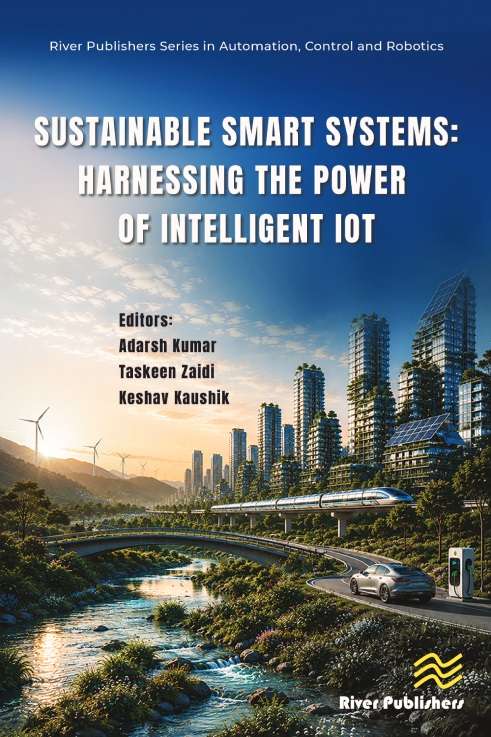
Sustainable Smart Systems: Harnessing the Power of Intelligent IoT Forthcoming
Editors:
Adarsh Kumar, UPES, Dehradun, India; Universitat Politècnica de Catalunya, Manresa, Barcelona, Spain
Taskeen Zaidi, Symbiosis University of Applied Sciences, Indore, India
Keshav Kaushik, Sharda University, Greater Noida, Uttar Pradesh, India
ISBN: 9788743815914 (Hardback) e-ISBN: 9788743815921
Available: February 2027
The Intelligent and sustainable Internet of Things has recently gotten a lot of praise because of its new frontiers applications. Several research and reports have indicated that sustainable IoT-based computing paradigms, such as smart homes, smart agriculture, and other applications, can drastically impact our daily lives. The evolution of the sustainable IoT-based paradigm has reached a fork in the road. Sustainable IoT-based computing frameworks/systems can act as simple sensing devices or regular information systems with established protocols and regulations if they lack intelligence. As a result, it may not be able to provide the services we need to push the smart computing paradigm forward. The intelligent and sustainable IoT computing paradigm can handle the huge amounts of data generated by linked devices and intelligent systems. This massive amount of data from sustainable IoT devices and systems contains a wealth of information. All that is required is the development of wiser systems through the use of intelligent technologies that can give us with accurate and efficient decision-making. New business models, digital transformation, and design and deployment of sustainable IoT solutions for all smart applications, as well as Novel Architecture and Protocols for sustainable IoT. The fundamental goal of this edited book is to discover, analyse, and provide inspiration for the future vision of the advanced 'Internet of Things' by imagining traditional sustainable IoT. The main purpose is to give a better learning platform for senior undergraduate and graduate students, researchers, scientists, ecologists, biologists, newcomers to the field, computer scientists, statisticians, and industry experts to adopt successful approaches for various applications. The major goal is to give a foundational and cohesive set of ideas about the sustainable IoT for practise, as well as to cultivate eager learners through implementations to tackle cutting-edge challenges by graduate and post-graduate students, interdisciplinary researchers, and others.
- 5G Networks
- AI-Driven Threat Detection
- Anomaly Detection
- Artificial Intelligence of Things (AIoT)
- Autoencoders
- Automated Defect Detection
- Blockchain
- Blockchain-as-a-Service (BaaS)
- Blockchain for IoT Security
- Blockchain Technology
- Cloud Forensics
- Cloud Security
- Clinical Trials
- Consensus Mechanisms
- Convolutional Neural Networks (CNNs)
- Cryptography
- Cyber Kill Chain
- Cybersecurity
- Data Integrity
- Deep Learning
- Demand Response
- Digital Evidence
- Digital Twins
- Distributed Energy Resources (DERs)
- Edge-AI Computing
- Edge Computing
- Edge Computing Security
- Edge Intelligence
- Electronic Health Records (EHR)
- Electronic Health Records (EHRs)
- Energy Storage Systems
- Ensemble Learning
- Federated Learning
- GDPR Compliance
- Healthcare
- Healthcare IoT
- Healthcare IoT (H-IoT)
- Hybrid Blockchain
- Hybrid Edge-Cloud Architecture
- Image Segmentation
- Incident Response
- Industrial Internet of Things (IIoT)
- Interoperability
- Internet of Things (IoT)
- Intrusion Detection System
- IETF Standards
- ISO/IEC 27400
- Jurisdictional Challenges
- Large Language Models (LLMs)
- LSTM Networks
- Machine Learning
- MediLedger
- Medical Imaging
- MITRE ATT&CK Framework
- Mirai Botnet
- Multimedia Computing
- NIST SP 800-213
- Off-Chain Storage
- PACS (Picture Archiving and Communication Systems)
- Patient Consent
- Patient Consent Management
- Pharmaceutical Supply Chain
- Physical Security
- Predictive Maintenance
- Proof-of-Authority (PoA)
- Ransomware
- Real-Time Processing
- Reinforcement Learning
- Renewable Energy Integration
- Scalability
- Self-Healing Security Systems
- Sidechain
- Smart Cities
- Smart Contracts
- Smart Grid
- Supply Chain Management
- Sustainability
- Telemedicine
- Virtual Power Plants (VPPs)
- Vision Transformer Models
- Zero Trust Architecture
- Chapter 1: Advanced Machine Learning and Deep Learning techniques for IIOT
- Chapter 2: Edge Computing in the Context of Advanced Machine Learning and Deep Learning for Industrial Internet of Things (IIoT)
- Chapter 3: Advanced Security System for Industrial Internet of Things (Cyber, Physical, Network, Cryptography, Health Security, Cloud, Information, Internet)
- Chapter 4: Navigating the Fog: Modern Approaches to Cloud Forensic Investigations
- Chapter 5 : Sustainable Advancing Role of AI in IoT for Intelligence Computing Systems
- Chapter 6: Advanced Image Processing and Multimedia Computing Techniques for IIoT
- Chapter 7: Blockchain For Secure 5G-IoT Communication
Â
- Chapter 8: Sidechain and Blockchain for Scalability in Healthcare Services
Â
- Chapter 9: Blockchain and Healthcare: Building a Trusted Ecosystem
Â
- Chapter 10: Predictive Maintenance in Smart Industries: A Deep Learning Approach
Â
- Chapter 11: IOT Security Framework for Standards & Regulations for Sustainable Global Networking Strength
Â
- Chapter 12: Leveraging AI For Strategic Market Participation Of Microgrids: Opportunities And Innovations